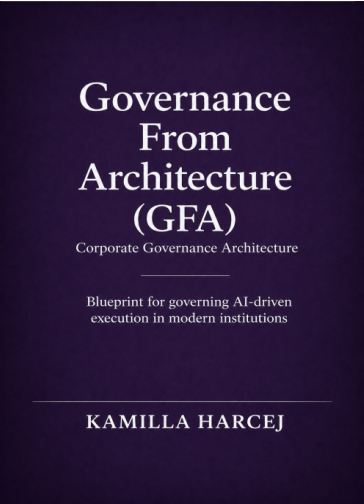
Executable Governance Architecture

Governance
From Architecture

Constitutional execution control for AI systems, autonomous workflows, and institutional decision environments.

GFA establishes governance as runtime architecture rather than descriptive oversight. In governed systems:

  • intelligence may propose,
  • workflows may execute,
  • but architecture determines admissibility, authority, and execution legitimacy.

Intelligence proposes.
Architecture decides.

Governance From Architecture (GFA) — Core Specification v1.0 by Michal Harcej
Versionv1.0
StatusCore Specification
Specification LayerConstitutional Authority
AuthorMichal Harcej
FrameworkTauGuard / TauDIL
Constitutional Runtime Sovereign
Governance StateACTIVE
Authority ModelENFORCED
Execution GateVERIFIED
Escalation PathsACTIVE
Drift StatusSTABLE
Override ConditionsCONSTRAINED
Admissibility EngineOPERATIONAL
Execution TraceabilityCOMPLETE

Governance does not fail because principles changed.
It fails because execution conditions changed.

Modern governance frameworks were designed for human decision latency, supervisory review, and descriptive compliance environments.

AI systems collapse those assumptions.

Once intelligence can trigger execution, governance becomes execution control.

The Governance Gap

Legacy Oversight vs Architectural Authority

Descriptive governance assumes human decision latency and supervisory review. Architectural governance assumes neither. The distinction is not modernization — it is the difference between policy and execution control.

Traditional Model

Descriptive Governance

  • Policy interpretation
  • Post-hoc audit
  • Supervisory review
  • Delayed escalation
  • Procedural trust
  • Human assumption layers
  • Compliance-by-attestation
  • Documentation as governance
GFA Model

Executable Governance

  • Deterministic gates
  • Runtime admissibility
  • Authority-bound execution
  • Constitutional constraints
  • Structural refusal
  • Immutable operational lineage
  • Compliance-by-construction
  • Architecture as governance
Doctrinal Foundation

Architecture determines:

In intelligent systems, governance is no longer documentation.
It becomes executable infrastructure.

Governance Architecture

The Six Operating Components

Six structural components forming the executable governance model. Each operates at runtime. Each is verified continuously. Together they constitute the constitutional infrastructure.

I

Deterministic Gate

All execution passes through bounded admissibility evaluation. No action proceeds without verified authorization. The gate is the constitutional checkpoint — deterministic, auditable, and non-negotiable.

II

Constraint Registry

Governance conditions become executable runtime constraints. Policies are not documents to be interpreted — they are compiled invariants enforced at every execution boundary.

III

Authority Mapping

Authority is structurally bound to roles, mandates, and execution scope. No actor — human or algorithmic — operates outside their architecturally defined authority envelope.

IV

Evidence Artifacts

Every governed action produces cryptographically verifiable lineage. Audit is not reconstruction — it is direct verification of immutable operational record produced at execution time.

V

Failure Semantics

Refusal, HOLD, escalation, rollback, and quarantine are explicit runtime states. Failure modes are architecturally defined — not improvised by operators under pressure.

VI

Drift Enforcement

Systems continuously verify constitutional alignment, operational admissibility, and authority continuity. Governance integrity is a measured, monitored, and enforced property — not assumed.

Execution Model

The Constitutional Pipeline

Every execution request flows through the constitutional pipeline. Intelligence proposes. Authority validates. Architecture authorizes. Action executes. Lineage records. No step is optional. No step may be bypassed.

Intelligence
Proposal
━ Admissibility Gate ━
Authority Validation
Mandate Evaluation
Constraint Resolution
Execution Authorization
Action
⌘ Immutable Lineage
Drift Analysis

Parametric Drift vs Constitutional Drift

Most governance systems monitor whether the model still works. Very few monitor whether governance itself still functions. The latter is the more dangerous failure mode — and the less detected.

Type I — Observable

Parametric Drift

  • Model behavior changes
  • Statistical degradation
  • Prediction instability
  • Semantic drift
  • Performance regression
  • Output distribution shift
Type II — Architectural

Constitutional Drift

  • Authority boundaries erode
  • Escalation conditions weaken
  • Execution legitimacy degrades
  • Governance invariants decay
  • Audit chain integrity loss
  • Override accumulation

Most governance systems monitor model quality.
Very few monitor whether governance itself remains structurally enforceable.

Applied Governance

Constitutional Modules in Operation

GFA principles operationalized across institutional execution environments. Each module enforces structural governance — not advisory oversight.

Module · Financial

Governed Credit Adjudication

  • Proposal ≠ approval — model recommendation does not authorize lending
  • Authority-bound lending decisions tied to mandate scope
  • Escalation containment for boundary cases
  • Rollback traceability with cryptographic lineage
  • Bias monitoring as constitutional invariant
StatusEnforcing
Module · Regulatory

Runtime Compliance Enforcement

  • Live admissibility verification at every action boundary
  • Execution denial for non-compliant operations
  • Policy-bound state control across jurisdictions
  • Continuous regulatory framework alignment
  • Audit-ready evidence generation in real time
StatusVerified
Module · Autonomous

Autonomous Workflow Governance

  • Bounded execution within architecturally defined scope
  • Mandate verification before any autonomous action
  • Structural override constraints — no implicit escalation
  • Multi-agent authority isolation
  • Constitutional checkpoint at every workflow boundary
StatusActive
Enterprise Consequence

The problem is no longer AI capability.
The problem is uncontrolled execution authority.

As AI systems become operational:

  • liability accelerates,
  • execution latency collapses,
  • human supervision weakens,
  • and governance failure becomes architectural rather than procedural.
Capital Exposure
§
Regulatory Exposure
Sovereignty Exposure
Authority Drift
Escalation Failure
Runtime Inadmissibility
Governance Maturity

The Four-Stage Maturity Model

Institutional governance evolves through four architectural stages. Most enterprises operate at Level 1 or 2. AI-operational environments require Level 3 or 4 — or they will fail under operational pressure.

Level
I

Policy Governance

Documents. Reviews. Human supervision. Governance lives in policy documents, manual review cycles, and human approval workflows. Effective for slow, deliberate decision environments. Insufficient for autonomous execution.

Level
II

Automated Governance

Rule engines. Compliance workflows. Operational monitoring. Governance partially automated through rule engines and compliance platforms. Still depends on human interpretation at decision points. Detection-oriented, not control-oriented.

Level
III

Structural Governance

Deterministic authority. Executable admissibility. Runtime constitutional enforcement. Governance compiled into architectural invariants. Authority bounded at execution time. No reliance on detection after the fact.

Level
IV

Constitutional Infrastructure

Architecture itself becomes governance. No separation between system architecture and governance architecture. Execution legitimacy is a structural property. Sovereignty is architectural. The system cannot operate outside its constitutional envelope.

τ
Final Chapter

Governance Beyond AI

This transition is larger than machine learning.

It represents a migration of execution power from:

  • institutions,
  • procedures,
  • and human review

toward:

  • runtime systems,
  • architectural gates,
  • and executable authority models.

Supervision is not sovereignty.
Architecture is sovereignty.

The Choice Before Institutions

Institutions must choose before failure chooses for them.