Security Governance Framework

Security
From
Architecture

Design systems where entire classes of failure become structurally impossible.

SFA is a deterministic security doctrine focused on:

  • finite state architectures,
  • admissible execution,
  • explicit authority boundaries,
  • and structural impossibility instead of reactive defense.
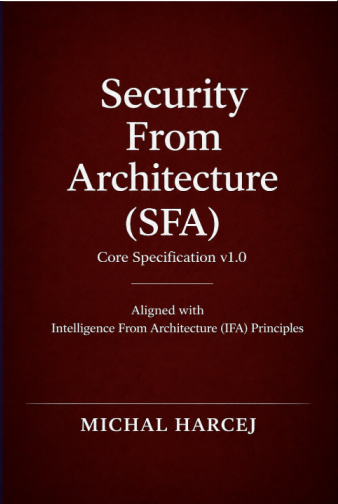
Security From Architecture (SFA) Book Cover — Core Specification v1.0 by Michal Harcej
Version v1.0
Status Core Specification
Specification Layer Security Doctrine
Author Michal Harcej
Framework TauGuard / TauDIL
Live Security State Structural Mode
Attack Surface DEFINED
Undefined States 0
Transition Model VERIFIED
Authority Boundaries ENFORCED
Invariant Status STABLE
Exception Paths NONE
Structural Mode ACTIVE
If a system is not permitted to do something,
it should not be able to do it at all.

Traditional Security Attempts To

  • Detect threats after they emerge
  • Monitor behavior during execution
  • Respond to incidents post-breach
  • Patch vulnerabilities after discovery
  • Assume trust until proven otherwise

SFA Constrains Possibility Itself

  • Define the total state space explicitly
  • Eliminate undefined execution paths
  • Enforce authority at architecture level
  • Make violations structurally unreachable
  • Require proof before trust is granted

The objective is not better reaction.

The objective is architectural impossibility.

Foundational Principles

Six Structural Axioms

Each principle defines a structural property of a secure system. Not aspirations. Not best practices. Architectural constraints that eliminate entire categories of vulnerability by construction.

Principle I

Attack Surface as Architectural Artifact

"What you do not define, the attacker will discover."

  • Explicitly bounded interfaces
  • No undefined exposure
  • No accidental execution surfaces
  • Attack surface is versioned and auditable
Principle II

Security Through Impossibility

Undefined states must be structurally unreachable.

  • Security enforced through architecture
  • Not runtime hope or monitoring
  • Violation paths removed from state space
  • No reliance on detection after execution
Principle III

Input as Formal Grammar

The system does not process what it does not understand.

  • All admissible input formally constrained
  • Undefined input rejected before processing
  • No implicit type coercion or interpretation
  • Grammar enforcement at system boundary
Principle IV

Authentication as State Precondition

Identity is not metadata. Identity is a structural precondition for execution.

  • No anonymous execution paths
  • Identity verified before state access
  • Authentication governs capability activation
  • Cryptographic proof, not assertion
Principle V

Authorization as Transition Validity

Permission is not possession. Authorization governs valid state transitions.

  • Authorization evaluated per transition
  • No cached or inherited permissions
  • Authority scope bounded at architecture level
  • Every action requires explicit transition validity
Principle VI

Layered Invariants

Security emerges from independent invariant enforcement across all operational layers.

  • Each layer enforces its own invariants
  • No single layer is trusted in isolation
  • Invariant violations halt execution immediately
  • Defense-in-depth through structural independence
Architectural Model

Admissible Execution Space

The architectural boundary separates what is structurally possible from what is structurally impossible. There is no gray zone. No undefined behavior. No implicit trust.

Protected Core Admissible
Execution Space
Attack Surface
Boundary
Explicit interface definition
Capability
Constraints
Bounded operational authority
Identity
Layer
Cryptographic preconditions
Transition
Governance
State transition validation
Isolation
Zones
Blast radius containment
Audit
Integrity
Immutable evidence chain
Temporal
Constraints
Time-bounded execution
Invariant
Engine
Constitutional enforcement
▬ ▬ ▬   STRUCTURALLY IMPOSSIBLE   ▬ ▬ ▬
Comparative Analysis

Why Modern Security Fails

Traditional security is reactive by design. SFA is prescriptive by architecture. The distinction is not incremental improvement — it is a fundamentally different model of what security means.

Traditional Security
  • Reactive — respond after breach
  • Detection dependent — monitor for anomalies
  • Undefined behavior tolerated — edge cases ignored
  • Expanding attack surfaces — growth increases risk
  • Runtime exception culture — errors handled ad hoc
  • Trust-based operation — assume good faith
  • Perimeter defense — protect boundaries only
  • Compliance-driven — checkbox security
Security From Architecture
  • Prescriptive — define what is possible
  • Constraint-based — enforce structural limits
  • Finite state governance — every state is explicit
  • Explicit attack surface — defined and versioned
  • No undefined execution — impossible by construction
  • Structural enforcement — prove before trust
  • Depth through invariants — every layer enforces
  • Architecture-driven — security is structural property
Constitutional Articles

The SFA Specification

Five constitutional articles forming the deterministic security doctrine. Each article defines a structural mandate — not a recommendation. Systems either comply architecturally or they do not.

Article I

Attack Surface Governance

The system MUST explicitly define its attack surface. Every interface, endpoint, protocol binding, and execution boundary must be declared, versioned, and subject to architectural review.

Undeclared interfaces are structurally prohibited. The attack surface is not discovered through penetration testing — it is defined through architectural specification. Any interface not explicitly declared does not exist in the system's execution model.

Article II

Finite Security States

All valid security states and transitions MUST be explicitly defined. The system operates as a finite state machine where every reachable state is known, authorized, and auditable.

There are no implicit states. No emergent states. No states that exist because they were not explicitly prohibited. The total state space is bounded, enumerable, and verifiable at any point during execution.

Article III

Structural Impossibility

Undefined behavior MUST NOT be executable. Any execution path not explicitly authorized by the architectural specification is structurally unreachable — not merely prohibited.

The distinction between prohibition and impossibility is fundamental. Prohibited actions can be attempted. Impossible actions cannot be constructed. SFA requires the latter.

Article IV

Architectural Enforcement

Security properties MUST be enforced structurally, not procedurally. No security-critical property may depend solely on correct procedural execution by humans, administrators, or runtime processes.

Procedural security assumes correct behavior. Structural security guarantees it through architectural constraints. When human judgment can bypass a security control, the control is procedural. SFA requires controls that cannot be bypassed by any actor.

Article V

No Bypass Paths

Overrides, hidden execution paths, and undocumented authority transitions MUST NOT exist. Every execution path is declared, governed, and subject to invariant enforcement.

There are no backdoors. No administrative overrides that bypass governance. No emergency exceptions that circumvent structural controls. If an action cannot be authorized through the constitutional governance chain, it cannot be executed — regardless of the actor's role or claimed authority.

Operational Visualization

SFA Runtime Governance

SFA doctrine operationalized through TauDIL constitutional infrastructure. Every metric represents a structural property — not a statistical observation. Live, deterministic, continuously verified.

Attack Surface Registry
Declared Interfaces847
Undeclared Exposure0
Surface Versionv4.2.1
Last Audit12 min ago
Surface DriftNONE
Invariant Health
Active Invariants2,341
Violations Detected0
Enforcement Rate100%
Layer Coverage7/7
Invariant ModeENFORCING
Transition Audit Chain
Transitions Logged1,847,293
Chain IntegrityINTACT
Invalid Transitions0
Proof VerificationCONTINUOUS
Last Chain Commit0.4s ago
Cryptographic Integrity
Active Signatures12,847
Key RotationON SCHEDULE
Certificate StatusVALID
Hash AlgorithmED25519+SHA-256
Tampering Events0
Authority Boundary Verification
Authority ChainsVERIFIED
Scope Violations0
Boundary ModeENFORCING
Escalation Attempts2 BLOCKED
Override PathsNONE
Admissibility Engine
Requests Evaluated94,281
Admissible93,847
Rejected434
Evaluation Latency<0.8ms
Policy Versionv7.1.0

SFA doctrine operationalized through TauDIL constitutional infrastructure · Live structural data

Σ
SFA Doctrine
"This is not a book about defending systems
that are allowed to lie about themselves.

It is about building systems that cannot."
Build Governable Security Infrastructure

Deterministic Runtime Governance
for Critical Systems

Structural security for systems where failure is not an acceptable outcome.